Showing posts with label WoEP. Show all posts

Saturday, 24 May 2014

Subcritical Mass

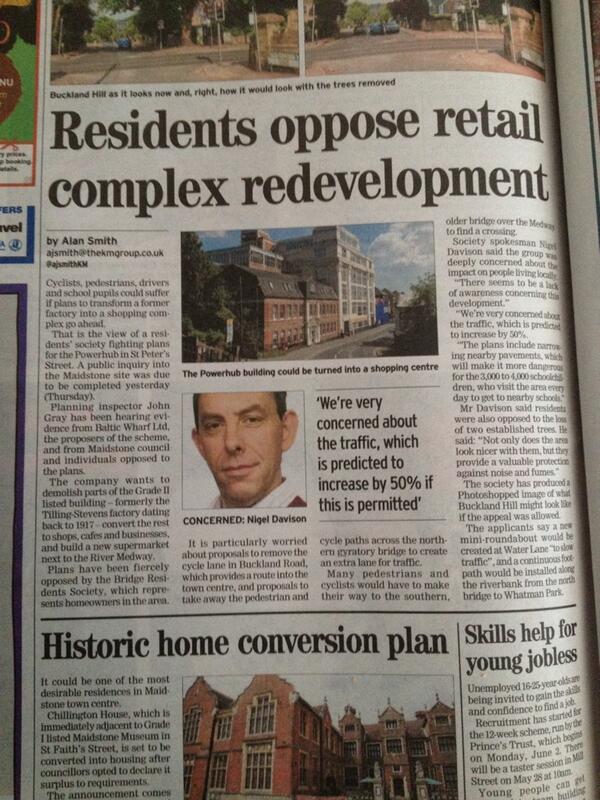
In Maidstone a developer is proposing that the traffic congestion side effects of a proposed development by narrowing a pavement and taking away a shared use bike path, "take away the pedestrian cycle paths across the northern gyratory bridge to create an extra lane for traffic"


This shows the sheer cynicism of property developers, who really don't gieve a fuck about the health of the livability of the towns they want to "develop" -be it the health of the high street or the health of pedestrians.

All they want is fat lazy people to drive to the supermarkets, stock up on whatever crap they want to eat, drive home and then watch TV until the next time to stock up. If its one of the people they want to sell a flat to they probably care that the customer doesn't die of CHD before the mortgage is paid off -though as that's really a matter for the concern of the mortgage lender, they probably don't give a fuck about that either.

Bridges are the choke points of cities. If there's a river, you either go over it or under it -or you don't cycle to your destination. They are even worse than dual carriageways, where there's often a wait-for-ten-minutes-pig-pen crossing. Bridges are all or nothing.

In London, the bridges are key places where cyclists are threatened -think Blackfriar's Bridge. Similarly in Bristol the BRT2 proposal wants  to take away one of the safer River Avon crossings for bendy-buses. It's precisely because those bridges are so valuable for all forms of transport that people working on car traffic flows, or bus rapid transport fanatics in city planner offices (yes, West of England Partnership -that does mean you) look at the current bridges and say "we can increase the capacity of this bridge by taking away the walking and cycling options"

In London, there were enough cyclists across the city that even when a fraction turned up, it was enough for high visibility mass protests. In Bristol, plans by the WoEP BRT-lovers got the protests out on the Bristol-Bath route, but for BRT2 things have been more subdued. The smaller routes have less mass use -but its those routes that join up the city and create the integrated routes you need for a cycle infrastructure.

Lose the bridges and you lose the integrated routes forever. Lose the integrated routes and your city will never be safe to cycle.

If London cyclists need to keep coming out to remind TfL of their responsibilities, if even Bristol has its work cut out -imagine what it is like in towns with less cyclists. There simply won't be enough people to oppose the plans, and the plans will go through. What protesters do come out will appear to be a few oddballs who don't deserve any space on roads they don't pay for.

S gloucs is generally a lost cause -if it has strengths it is

  1. There's cycling support from Bristol, both commuters into the city, and to the North Fringe.
  2. The main cycle route -the railway path- is joined up to Bristol and Bath, so can't be taken away on its own. All SGloucs can do is paint random give way signs, put up the odd chicane (and remove them, except at the school crossing), and do nothing in terms of street lighting or signing access to the path from the roads nearby.
  3. the cycle path by the ringroad (the unlit one, with the dodgy crossings and leaves on it) is raised enough away from the road that it isn't easily converted into another lane of the A4174. If that wasn't the case -it'd probably be gone by now, converted into a pretend sustainable lane with a 2+ sign that cyclists could also use -along with HGVs.
Bath? The A4 London Road shows the council's view: an ASL is all the cyclists need, and residents parking matters more than off street cycling. It took protests for the council to even think of cyclists, and even there you get half-hearted proposals from road planners that resent being told what they should be doing.

Smaller towns get it even worse. Maidstone shows what could happen -to see it in action today look at somewhere like Southampton, where their council's street 'visions' never show a bicycle, or Weston super mare, where they take pride in their mediocrity, adding bike paths on new roads purely to say the works address "all transport needs", when in fact the cycle route is so short and shit nobody would touch it

And here lies problem. Cycling numbers are falling outside London, Bristol and a few other densely populated cities -and even there the takeup is patchy.  This has got the smaller towns into a vicious circle
  1. the number of people driving creates pressure for action on reducing congestion
  2. the sole solution to congestion that anyone can conceive is more traffic lanes
  3. the sole space for these lanes in places where there is no room to expand is the side of the roads -the footpaths and what mediocre shared use paths there are
  4. as these were already shit paths and not part of an integrated route, they weren't used enough to make cycling a normal activity
  5. the aren't enough people to stand up for the paths, so they get taken away
  6. more people end up driving
Is there hope? Maybe in the medium-size cities, maybe with local regions within the smaller towns.  WSM is a lost cause for now. Bath could be improved -it is a town with many students, it's not great to cycle round, but it's not so awful you fear for your life everywhere. It's connected up with bristol via the RP, it's got the Twin Tunnels. What it lacks is a good option by the A4/London Road that doesn't involve crawling along the overcrowded towpaths -not a commute option, especially in winter- or burning thighs on the hill climbs above the A4. Then there's the gyratories by the train station, and that mess in the centre. 

Cyclists of Bath: follow Bristol and London -as if you can't, places like Southampton and Maidstone are fucked!


Friday, 17 January 2014

Rapid Transit vs Cycling

Some people may -naievly- assume that major public transport projects will be good for cycling

No.

BRT planners view cycle routes as places they can take from cyclists "for the greater good", and so introduce BRT services -without incurring the controversy which comes from taking away road space from cars.

Magnatom has just discovered this, with a shared bike/bus route being turned into a bus only route.

Bus and bike don't coexist well even on shared bus lanes -there's a bus driver on a schedule trying to get to the next stop, a cyclist worrying about the bus up their arse, and, if the bus gets past, a bus blocking their progress at the next stop. Everyone slows each other down. And then there's the taxis, and in Bristol, the minicabs, who often treat cyclists worse than bus drivers .

One fix here, the CEoGB solution: segregate the cycle route.

The bus route planners solution: segregate the bus route by banning cyclists.

And where do you build a segregated bus route? You can't easily do it on rush-hour only bus lanes, where keeping cars out of them is a constant battle -its the perennial bus route vs parking conflict.

The other road option: dual carriageways and motorways. Urban motorways could be a suitable location: M8, M77. M32, M4 into London, and the like. Except try building there and the planners go headlong into battles with the press over "bus bring driving chaos" stories.

It is politically much more expedient to look at the cycle routes -the routes that have grown into the "unused spaces" in the city, ones that the planners can look at and say "that'll do"

And the cycling traffic? They get ignored and discounted in spreadsheets that look at the catchment area of the BRT stops, make an assumption that some vast percentage will switch to the BRT -and use that as the foundation for their equations. Nobody ever does that for cycle routes, because they discount the idea that more than a small niche set of users would use them.

And even then, when the spreadsheet says "this is not a good option", they pick it because of its lower political cost, and because of the momentum that a multi-million pound project can get: central government funding, the route designers will have nice offices in the council buildings, briefing sessions, backing from the bus companies. In their own way, they are their own version of the Road Lobby: the bus lobby.

The WoEP  are the threat here in CUBA, "Counties that Used to Be Avon". The "West of England Partnership" are team based in Bristol Council's road planning offices, trying to bring Bus Rapid Transit to the city by destroying the long distance cycle routes as well as any greenery in the more deprived parts of the inner city.

There was  plan in the early 1990s for a tram service to run from Bristol to Bath. If it had been built, it would have been popular, and could maybe even have extended round the ring road to the North Fringe. It wasn't, and instead over 20 years it became the most widely used cycle route in Britain. It is a mixed use route -which does create conflict, but that feature was a benefit in 2006? when the WoEP wankers came up with their BRT plan: BRT1, BRT2, BRT3.

The BRT proposals were for a set of BRT routes, linking the town and the city, and circling the inner city by way of the inner-circuit road, inner Bristol's Leeds-era ugliness.

One of them -BRT3?- was to be along the M32, which would be downgraded to a trunk route, and a new bus lane added -presumably in the centre. Even there though, it would run "along a stretch of the river frome" -which glosses over the fact that this stretch of the frome has a name, Riverside Park.

BRT4: Malago greenway. "greenway" in the title is the flag there -it was the parkland and path that runs along the Malago stream to Bedminster. This is now part of the Hengrove cycle way, though streetview shows that the bike route meanders through suburban chav-land where pavements are for parking your clapped out cars that you "can't do withoout", and no doubt forcing you to plead exceptional hardship when your speeding tickets catch up with you.

Another -BRT1 turned out to be planned to go through the Railway Path. That was the one that was sprung on the city with the plans nearly complete.

The economics spreadsheets slowed that the M32 based BRT route was the one that would be the most popular and have the best Return On Investment.

Why then did the bus planners pick on the railway path -why pick on the cyclists?

Technical: there was a straight line there with underpasses and things -all they had to do was throw off the cyclists, block pedestrian access and they've got a bus route. It was the easiest route to build.

Political: it was felt it would generate less opposition from the people in the city.

They targeted the bike route because they felt that the cyclists would be an easier target -willing to acquiesce to some shit proposal that would give them a narrow concrete route by a bus lane, less entry and exit points, and no pleasant greenery.

What saved the path? Why is it still a showcase? Because the cyclists across the city did come out -all over the wards, they got in touch with their councillors to complain. Equally importantly, the residents of the inner city came out too to defend their park -and their walking route to school, to the city, to the shops in Fishponds. Mass protest saved that route, and the only reason that worked was the volume of cycle traffic (broad support across the city), and a key feature of inner east bristol (political activists, many motivated locals)

The campaigners one: for  now. But no doubt someone has their designs in some road-planner CAD tool, which will on a sharepoint server there barring some disk corruption or  file format unreadability.

What has proceeded instead is BRT2, which

  • Cuts over Prince St Bridge, quiet bridge crossing
  • Cuts over the "old" railway bridge by Cumberland Basin.
 The Cumberland Flyover is one of those "do not cycle unless you are an aggressive lycra-roadie" -not a utility route. Streetview shows a cyclist in each direction, but if you look at them, you can feel the fear coming off them, brave cyclists in a street system that is not designed for them.

In comparison, the railway bridge is empty -making it the one most people use; the nice one. BRT route runs along the harbour, which is part of the Cycle City route, the festival way.

Why did the BRT team choose this route? Technical and Political expediency. Bridges they could use, no real opposition. And this time: no so much. The selling point of the BRT2 route is that it will be way for residents of North Somerset to park and ride in, after they drive in from their mock-rural dream, the one where Elfan App Rees snickers when asked if he'd cycle a bike path he'd just defended as "cyclists should be grateful". You can't sell the notion of cycle commuting eight miles to a council where they expect a shit slowing route 15 metres long, 100cm wide and on the squashable side of a crash barrier. Whereas BRT? Its got money, ambition and it doesn't take away road space.

That's why the cyclists get stuffed by public transport projects: the bike routes are juicy targets and we cyclists generally lack the political clout to defend it.